
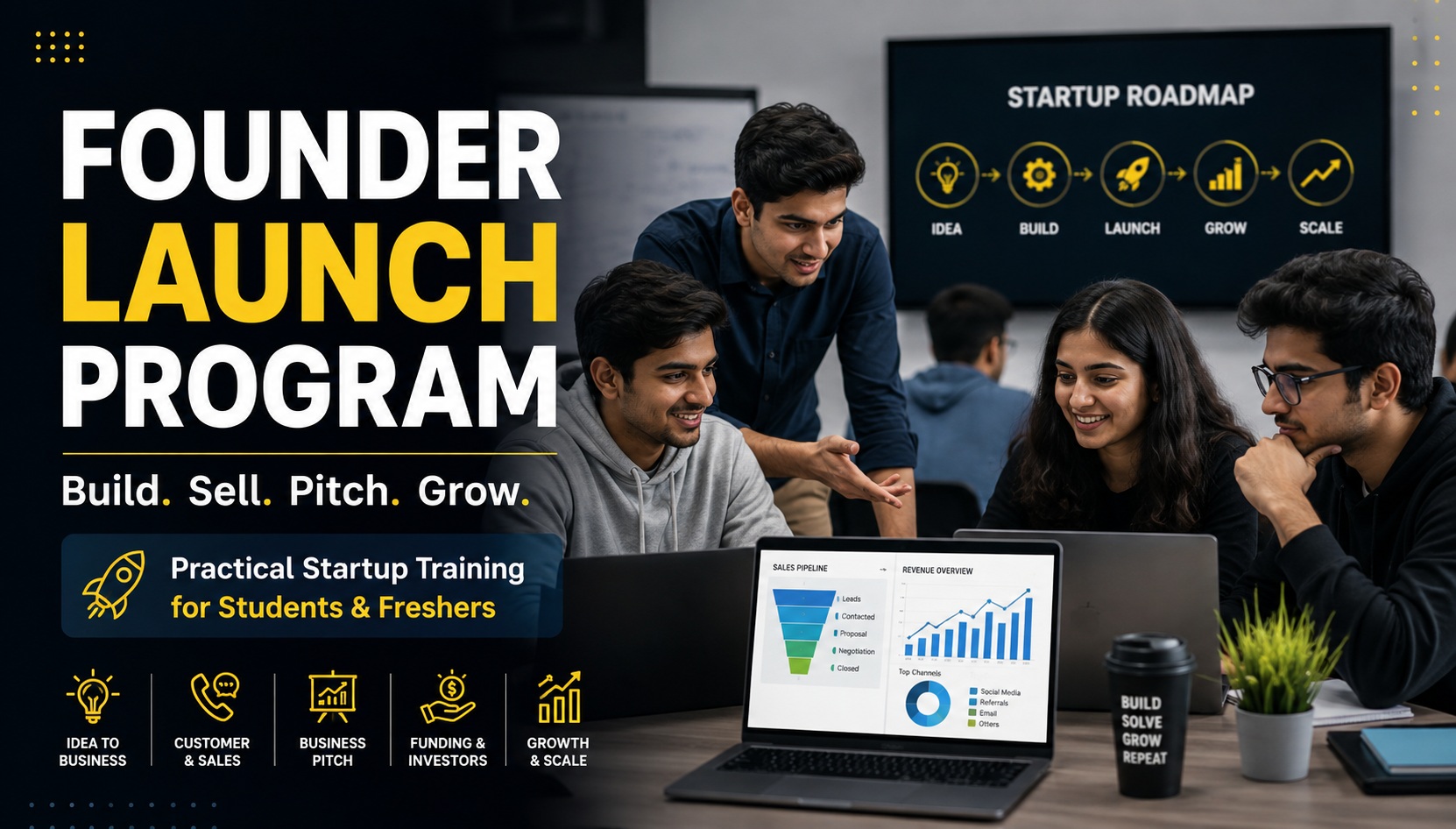
Founder Launch Program
Most business courses end where the real work begins. The Founder Launch Program
starts there instead — a practical, classroom-based entrepreneurship program for
students, freshers, and aspiring founders who want to build, sell, pitch, and grow
an actual business, not just study one.
Over six months, you’ll work on your own idea from the first week: validating a real
problem, laying down your business foundation, learning how to acquire paying
customers, building a pitch that holds up under real questions, understanding how
funding actually works, and leaving with a growth plan you can act on immediately.
Don’t just learn about business — learn by building one.
What You Will Learn
- How to identify real business opportunities
- How to validate a business idea before you build it
- How to create a business model and a compelling offer
- How to build a first product or service
- How to find and approach real customers
- How to run a confident, professional sales call
- How to close customers and handle objections
- How to build a pitch that actually lands
- How to prepare for funding opportunities
- How to build systems and scale a business
Program Curriculum
Month 1
Discover — Find the Right Business Opportunity
The first month is about sharpening an entrepreneurial mindset and
uncovering business opportunities rooted in real customer problems —
not assumptions.
- Understanding how businesses actually make money
- Business vs startup vs freelancing
- Identifying problems genuinely worth solving
- Finding profitable markets and niches
- Understanding customer pain points
- Market and competitor research
- Defining your target customer clearly
- Generating and stress-testing business ideas
- Choosing the right business model
- Understanding B2B and B2C businesses
Practical Outcome:
By the end of the month, students walk away with a clearly defined
business opportunity, target customer, problem, and an initial
business model.
Month 2
Build — Turn the Idea Into a Business
With a validated opportunity in hand, students move from an idea on
paper to something they can genuinely present and sell.
- Creating a strong, differentiated value proposition
- Developing products and services
- Creating an MVP
- Business and brand positioning
- Brand name and identity
- Website and landing page fundamentals
- Creating service packages and offers
- Pricing strategy
- Creating proposals and quotations
- Customer onboarding process
- Payment and delivery process
Practical Outcome:
Every student works toward a real, sellable product or service — not
another theoretical assignment.
Month 3
Sell — Learn Real Customer Acquisition & Sales
Here, students build the one skill most founders can’t outsource early
on: getting customers.
- Finding potential customers
- Building prospect lists
- Cold calling
- WhatsApp outreach
- Email outreach
- Instagram and LinkedIn outreach
- Networking and referrals
- Writing outreach messages that get replies
- Starting genuine customer conversations
- Running discovery calls
- Understanding customer needs
- Presenting the offer with confidence
Students also take part in live sales role-play sessions — practicing
real conversations, getting direct feedback, and sharpening how they
communicate.
Practical Outcome:
Students leave the month with a repeatable customer acquisition and
sales process built specifically for their own business.
Month 4
Close & Grow — Convert Conversations Into Customers
This stage is about turning leads and conversations into real business —
actual signed customers, not warm interest.
- Sales call structure
- Understanding buying decisions
- Handling customer objections
- Price objections
- Negotiation fundamentals
- Closing techniques
- Follow-up systems that don’t get ignored
- Creating professional proposals
- Customer onboarding
- Customer retention
- Testimonials and referrals
- Upselling and cross-selling
Students are encouraged to take their learning straight into the real
market — approaching potential customers and applying what they’ve
practiced to their own business.
Practical Outcome:
A functioning sales pipeline, with a clear process for prospecting,
presenting, following up, and closing.
Month 5
Pitch — Present Your Business Professionally
A strong business idea isn’t enough on its own. Founders need to
communicate it clearly — to customers, partners, mentors, and potential
investors alike.
- Creating a powerful business pitch
- 30-second elevator pitch
- 3-minute business pitch
- Investor pitch fundamentals
- Problem and solution presentation
- Market opportunity
- Business model
- Competitive advantage
- Go-to-market strategy
- Traction and business progress
- Revenue model
- Basic financial projections
- Creating a professional pitch deck
- Presentation and communication skills
Students practice presenting their own businesses live and receive
direct feedback to sharpen the pitch further.
Practical Outcome:
A professional business pitch and presentation, ready for customers,
competitions, mentors, incubators, or funding applications.
Month 6
Fund & Scale — Build the Next Stage of the Business
The final stage shifts focus to growth, funding readiness, systems, and
a long-term roadmap for what comes after the program.
- Understanding bootstrapping
- Understanding grants and funding opportunities
- Incubators and accelerators
- Angel investors and venture capital basics
- Finding relevant funding opportunities
- Preparing funding applications
- Investor outreach fundamentals
- Understanding equity and dilution
- Business financial planning
- Revenue and profit tracking
- Customer retention and recurring revenue
- Building business systems
- Delegation and hiring
- Scaling operations
- Creating a 12-month growth roadmap
Practical Outcome:
A structured plan for growing the business, along with a clear view of
the funding or growth paths that suit it best.
Real-World Sales Training
Sales isn’t taught through slides here. Students practice communicating with real
customers and confidently presenting their own business, with feedback built into
every session.
- Customer calling practice
- Sales role-play
- Cold outreach
- Lead generation
- Discovery calls
- Objection handling
- Negotiation
- Closing
- Follow-ups
The goal is simple: build the confidence and practical skill needed to talk to real
potential customers, not just role-play in theory.
Startup & Business Formation
Students learn the fundamentals of turning an idea into an organized business, and
understand what needs to change as that business grows.
- Choosing an appropriate business structure
- Founder roles and responsibilities
- Partnership fundamentals
- Equity basics
- Business documentation
- Contracts and proposals
- Basic accounting concepts
- Financial planning
- Business compliance awareness
- Hiring and delegation
- Business systems and processes
Legal, tax, accounting, and investment decisions should be reviewed with qualified
professionals where required.
Funding & Investor Readiness
Students learn how funding actually works and how to prepare their business for
the opportunities that genuinely fit it — rather than simply being told that
funding exists.
- Bootstrapping vs external funding
- Grants and funding programs
- Incubators and accelerators
- Angel investors
- Venture capital basics
- Pitch deck preparation
- Financial projections
- Investor outreach
- Funding application preparation
- Understanding valuation and dilution
Important: The program teaches students how to prepare and apply
for suitable opportunities. Funding or investment is never guaranteed.
Learn Through Real Business Execution
The program is built around practical execution. Students work continuously on
their own business, rather than completing unrelated classroom exercises.
- Business idea validation
- Customer interviews
- Market research
- Product or service development
- Real sales practice
- Customer outreach
- Business presentations
- Pitch deck development
- Funding application preparation
- Growth planning
What Students Can Build During the Program
By the end of the program, students walk away with a far clearer understanding of
how to take a business from an initial idea to real-world execution.
Stage 01
Idea
Identify a problem, market, customer, and business opportunity.
Stage 02
Business
Develop the offer, product or service, pricing, brand, and business model.
Stage 03
Customers
Learn prospecting, outreach, customer conversations, sales, and closing.
Stage 04
Revenue
Apply sales and customer acquisition strategies to create real business
opportunities.
Stage 05
Pitch
Present the business professionally to customers, mentors, competitions,
incubators, or potential investors.
Stage 06
Growth
Create a practical roadmap for customer growth, systems, team building,
funding opportunities, and long-term expansion.
Who Is This Program For?
- College students who want to start a business
- Freshers exploring entrepreneurship
- Students with a business idea
- Students who want to turn their skills into a business
- Aspiring founders
- Beginners who want practical business experience
- Students interested in building scalable businesses
Don’t Just Learn Business. Build One.
The Founder Launch Program is designed to take students beyond business theory and
into practical execution — from finding an opportunity and building a business to
customer acquisition, sales, pitching, funding readiness, and growth.
Learn. Build. Sell. Pitch. Fund. Grow.