
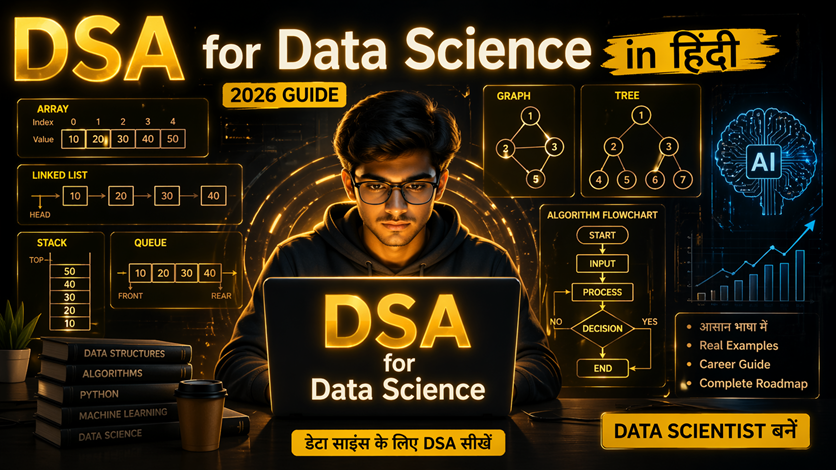
📊 DSA for Data Science – Complete Beginner to Advanced Guide
🚀 DSA क्या है? Data Science में क्यों जरूरी है?
Table of Contents
Toggleआज के समय में हर कोई Data Scientist बनना चाहता है — high salary, future growth और exciting projects के कारण। लेकिन एक बड़ी गलती जो ज़्यादातर beginners करते हैं, वो है सिर्फ tools सीखना — जैसे Python, Pandas, Machine Learning।
👉 लेकिन सच यह है कि सिर्फ tools जानने से आप एक strong Data Scientist नहीं बन सकते। आपको चाहिए एक ऐसी skill जो हर problem को efficiently solve कर सके — और वही skill है DSA (Data Structures & Algorithms)।
⚡ सबसे बड़ा सवाल
👉 अगर आपको DSA नहीं आता, तो Data Scientist job मिलना मुश्किल क्यों हो जाता है?
क्योंकि companies सिर्फ यह नहीं देखती कि आपको tools आते हैं या नहीं। वे यह देखती हैं कि आप problem को कैसे सोचते हैं, कैसे solve करते हैं और कितना efficiently solution बना सकते हैं।
Imagine करो — आपके पास 1 लाख rows का data है और आपको उसमें से pattern निकालना है। अगर आपको DSA नहीं आता, तो आपका solution slow होगा, inefficient होगा और real-world में काम नहीं करेगा।
📌 Real Life Scenario
मान लो आप एक Data Scientist हो और आपको Netflix जैसे platform के लिए recommendation system बनाना है। अगर आपको सही data structure और algorithm नहीं आता, तो system slow हो जाएगा और user experience खराब हो जाएगा।
👉 यही reason है कि बड़ी companies (Google, Amazon, Microsoft) DSA को बहुत seriously लेती हैं। चाहे role Data Science का हो या Software का — problem-solving skill हर जगह जरूरी है।
📌 DSA क्या है? (Simple Explanation)
DSA (Data Structures & Algorithms) एक तरीका है data को organize करने और problems को efficiently solve करने का। यह आपको यह सिखाता है कि data को कैसे store करें, कैसे access करें और कैसे process करें ताकि result fast और optimized हो।
आसान भाषा में समझें तो — 👉 Data Structure = data को रखने का तरीका 👉 Algorithm = problem solve करने का तरीका
जब ये दोनों combine होते हैं, तब आप powerful solutions बना सकते हैं जो real-world problems solve करते हैं।
🔥 Data Science में DSA क्यों जरूरी है?
- ✔ Large datasets को efficiently handle करने के लिए
- ✔ Faster computation और optimization के लिए
- ✔ Machine Learning models को improve करने के लिए
- ✔ Complex problems को logically solve करने के लिए
- ✔ Interviews crack करने के लिए
Data Science में आपको सिर्फ analysis नहीं करना होता, बल्कि आपको data को process भी करना होता है। अगर आपका algorithm slow है, तो आपका पूरा system slow हो जाएगा।
इसलिए DSA आपको सिर्फ coding नहीं सिखाता — यह आपको सोचने का तरीका सिखाता है।
❌ Biggest Myth
बहुत लोग सोचते हैं कि DSA सिर्फ software developers के लिए जरूरी है — लेकिन यह पूरी तरह गलत है। Data Science में भी efficient solutions बनाने के लिए DSA उतना ही जरूरी है।
अगर आप सिर्फ libraries use करना जानते हैं लेकिन अंदर क्या हो रहा है नहीं जानते, तो आप limited रह जाएंगे।
👉 DSA आपको surface level से उठाकर deep understanding देता है।
🚀 Future Perspective
आने वाले समय में Data Science और AI दोनों तेजी से grow कर रहे हैं। ऐसे में companies उन candidates को prefer करेंगी जिनके पास strong fundamentals हों — और DSA वही foundation है।
अगर आप beginner हैं, तो अभी से DSA सीखना शुरू करना आपके career के लिए game changer साबित हो सकता है।
🎯 इस गाइड में क्या सीखेंगे?
इस पूरे ब्लॉग में हम आपको step-by-step सिखाएंगे:
👉 DSA basics
👉 Algorithms
👉 Real Data Science use cases
👉 Complete roadmap
📊 DSA क्या है? (Beginner Friendly Explanation)
📌 DSA क्या है? (Short Answer)
DSA (Data Structures & Algorithms) एक ऐसा तरीका है जिससे हम data को efficiently organize करते हैं और problems को fast और logical तरीके से solve करते हैं। यह programming और data science दोनों में एक fundamental concept है।
अगर आप programming, data science या machine learning सीख रहे हैं, तो आपने “DSA” शब्द जरूर सुना होगा। लेकिन बहुत से beginners confuse रहते हैं कि आखिर DSA क्या है और यह इतना important क्यों माना जाता है।
आसान भाषा में समझें तो DSA दो चीजों का combination है:
- 👉 Data Structure = Data को store करने का तरीका
- 👉 Algorithm = Problem solve करने का तरीका
🧱 Data Structure क्या होता है?
Data Structure एक ऐसा तरीका है जिससे हम data को organize और store करते हैं ताकि उसे आसानी से access और modify किया जा सके।
उदाहरण के लिए:
- Array → ordered list (जैसे marks list)
- Stack → LIFO system (जैसे plates stack)
- Queue → FIFO system (जैसे line में खड़े लोग)
👉 सही data structure choose करना बहुत जरूरी होता है क्योंकि इससे performance directly affect होती है।
⚙️ Algorithm क्या होता है?
Algorithm एक step-by-step process है जिससे हम किसी problem को solve करते हैं।
उदाहरण:
- Sorting algorithm → data को arrange करना
- Search algorithm → data में element ढूंढना
👉 Algorithm का goal होता है:
✔ Fast execution
✔ Minimum memory use
✔ Accurate results
📚 Real-Life Analogy (Library Example)
मान लो आप एक library में जाते हैं और आपको एक specific किताब ढूंढनी है।
अगर books random रखी हुई हैं, तो आपको बहुत time लगेगा। लेकिन अगर books properly arranged हैं (category, author, index), तो आप जल्दी ढूंढ सकते हैं।
👉 यहाँ:
📦 Data Structure = Books को arrange करने का तरीका
🔍 Algorithm = Book search करने का तरीका
🚦 Traffic System Analogy
Imagine करो traffic system:
अगर roads organized नहीं हैं और signals नहीं हैं, तो chaos होगा। लेकिन structured system होने से traffic smooth चलता है।
👉 Same concept DSA में भी apply होता है:
✔ Proper structure → fast processing
✔ सही algorithm → efficient results
🔥 DSA क्यों जरूरी है?
DSA सिर्फ coding का part नहीं है — यह आपकी problem-solving ability को improve करता है।
- ✔ Faster programs बनाने में मदद करता है
- ✔ Memory optimization करता है
- ✔ Complex problems को आसान बनाता है
- ✔ Interviews में पूछे जाने वाले सवालों का base है
जब आप DSA सीखते हैं, तो आप सिर्फ code लिखना नहीं सीखते — आप सीखते हैं कि problem को कैसे analyze करें और best solution कैसे चुनें।
👉 यही skill आपको beginner से professional बनाती है।
📊 Data Science में DSA का Role
Data Science में आपको large datasets handle करने होते हैं।
अगर आपका algorithm slow है, तो आपका पूरा analysis slow हो जाएगा। इसलिए efficient data structures और algorithms बहुत जरूरी होते हैं।
- ✔ Large data processing
- ✔ Fast computation
- ✔ Optimized ML models
🧠 Summary
DSA एक fundamental concept है जो आपको efficient programming और problem solving सिखाता है। चाहे आप developer बनें या data scientist — DSA आपकी foundation को strong बनाता है।
📊 Data Science में DSA की जरूरत क्यों है?
जब लोग Data Science सीखना शुरू करते हैं, तो वे अक्सर Python, Pandas, Machine Learning और AI tools पर focus करते हैं। लेकिन एक चीज़ जो अक्सर ignore कर दी जाती है, वह है DSA (Data Structures & Algorithms)।
👉 सवाल यह है: क्या Data Science में DSA सच में जरूरी है? जवाब है — हाँ, और बहुत ज्यादा जरूरी है।
क्योंकि Data Science सिर्फ data analysis नहीं है, बल्कि इसमें large data को efficiently handle करना, fast computation करना और scalable solutions बनाना शामिल होता है — और यह सब बिना DSA के possible नहीं है।
📦 1. Big Data Handling
Data Science में आपको छोटे datasets नहीं, बल्कि लाखों-करोड़ों rows के data के साथ काम करना पड़ता है।
Imagine करो कि आपके पास एक dataset है जिसमें 10 million records हैं। अगर आपका data structure efficient नहीं है, तो:
- ❌ Data access slow होगा
- ❌ Processing time बहुत ज्यादा होगा
- ❌ Memory usage बढ़ेगा
👉 सही data structures (जैसे Hash Tables, Trees) का use करके आप data को faster तरीके से access और process कर सकते हैं।
उदाहरण:
✔ Hash Table → fast lookup
✔ Tree → hierarchical data
✔ Graph → network relationships
⚡ 2. Performance Optimization
Data Science में speed बहुत important होती है — खासकर जब आप real-time systems पर काम कर रहे हों।
अगर आपका algorithm inefficient है, तो आपका program slow हो जाएगा। उदाहरण के लिए:
- ❌ Linear search → slow (O(n))
- ✔ Binary search → fast (O(log n))
👉 यही difference DSA create करता है — efficient algorithm vs inefficient algorithm।
Data Science में जब आप बड़े datasets पर काम करते हैं, तो algorithm optimization directly performance को affect करता है।
🤖 3. Real-World Machine Learning Pipelines
Machine Learning सिर्फ model training नहीं है — इसमें पूरा pipeline होता है।
एक typical ML pipeline में शामिल होते हैं:
- ✔ Data collection
- ✔ Data cleaning
- ✔ Feature engineering
- ✔ Model training
- ✔ Prediction
👉 इन सभी steps में DSA का use होता है:
- Feature selection → sorting algorithms
- Data storage → efficient data structures
- Model optimization → algorithm efficiency
🎬 Example 1: Netflix Recommendation System
Netflix आपको movies और shows recommend करता है — लेकिन यह simple काम नहीं है।
Netflix लाखों users और करोड़ों data points analyze करता है:
- ✔ आपने क्या देखा
- ✔ कितना समय देखा
- ✔ किस genre को पसंद किया
👉 यहाँ DSA कैसे use होता है:
- Graph structures → user-item relationships
- Sorting algorithms → top recommendations
- Search algorithms → relevant content find करना
अगर DSA efficient नहीं होगा, तो recommendation system slow और inaccurate हो जाएगा।
🔍 Example 2: Google Search Engine
जब आप Google पर कुछ search करते हैं, तो result milliseconds में आता है — यह DSA की वजह से possible है।
Google billions of web pages को store और process करता है।
- ✔ Indexing → data structures
- ✔ Ranking → algorithms
- ✔ Searching → optimized search techniques
👉 अगर DSA नहीं होता, तो Google search seconds नहीं बल्कि minutes लेता।
🔥 Final Understanding
Data Science में DSA optional नहीं है — यह foundation है।
- ✔ Efficient data handling
- ✔ Fast computation
- ✔ Scalable systems
- ✔ Better problem solving
👉 अगर आप सिर्फ tools सीखते हैं, तो आप limited रहेंगे। 👉 अगर आप DSA सीखते हैं, तो आप real-world problems solve कर पाएंगे।
यही difference है एक average learner और एक professional Data Scientist में।
🚀 Ready to go deeper?
अब अगले section में हम DSA vs Data Science का clear comparison देखेंगे
⚔️ DSA vs Data Science – क्या अंतर है?
जब भी कोई Data Science सीखना शुरू करता है, तो उसके मन में एक common सवाल आता है — 👉 क्या DSA और Data Science एक ही चीज़ हैं?
इसका सीधा जवाब है — नहीं। DSA और Data Science दोनों अलग concepts हैं, लेकिन ये एक-दूसरे से जुड़े हुए हैं।
आसान भाषा में समझें तो:
👉 DSA = problem-solving foundation
👉 Data Science = data से insights निकालने की skill
📊 DSA vs Data Science (Comparison Table)
| DSA | Data Science |
|---|---|
| Coding & Problem Solving | Data Analysis & Insights |
| Logic based | Data driven |
| Algorithms focus | Machine Learning focus |
| Time complexity important | Accuracy & prediction important |
| Low-level thinking | High-level analysis |
| Used in coding interviews | Used in business decisions |
ऊपर दिए गए table से यह साफ हो जाता है कि DSA और Data Science दोनों का purpose अलग है — लेकिन दोनों एक-दूसरे को complement करते हैं।
🧠 DSA का Role
DSA आपको सिखाता है कि problems को logically और efficiently कैसे solve करें।
जब आप DSA सीखते हैं, तो आप सीखते हैं:
- ✔ Data को efficiently store करना
- ✔ Fast algorithms बनाना
- ✔ Complex problems को break करना
👉 यह skill आपको strong programmer बनाती है।
📊 Data Science का Role
Data Science का focus होता है data से insights निकालना और prediction करना।
इसमें आप सीखते हैं:
- ✔ Data analysis
- ✔ Visualization
- ✔ Machine learning models
- ✔ Business decision making
👉 यह skill आपको data-driven decision maker बनाती है।
🔗 DSA और Data Science का Connection
अब सबसे important सवाल — क्या Data Science के लिए DSA जरूरी है?
जवाब है — हाँ, लेकिन indirectly।
Data Science में:
- ✔ Data processing → efficient algorithms
- ✔ Large datasets → optimized structures
- ✔ ML models → performance optimization
👉 अगर DSA strong है, तो आपका Data Science work faster और better होगा।
📚 Simple Analogy
DSA = Engine
Data Science = Car
अगर engine strong नहीं है, तो car fast नहीं चलेगी। उसी तरह अगर DSA strong नहीं है, तो Data Science performance limited रहेगी।
🔥 Final Conclusion
DSA और Data Science अलग हैं — लेकिन दोनों मिलकर आपको complete skillset देते हैं।
- 👉 DSA = foundation
- 👉 Data Science = application
अगर आप सिर्फ Data Science सीखते हैं, तो आप tools तक सीमित रहेंगे। लेकिन अगर आप DSA + Data Science दोनों सीखते हैं, तो आप real-world problems solve कर पाएंगे।
🚀 Next Step
अब हम सीखेंगे Data Structures (Array, Stack, Queue) basics
🧱 Basic Data Structures क्या हैं? (Complete Foundation Guide)
अगर आप Data Science या Programming सीखना चाहते हैं, तो सबसे पहला और सबसे important concept है — Data Structures।
👉 Simple भाषा में:
Data Structure = Data को store और organize करने का तरीका
सोचो आपके पास लाखों records हैं — अगर वो properly organized नहीं होंगे, तो:
❌ search करना मुश्किल होगा
❌ analysis slow होगा
❌ system inefficient हो जाएगा
👉 यही problem Data Structures solve करते हैं।
📊 पहले यह समझ लें
अगर आपको Data Science basics clear नहीं हैं, तो पहले यह पढ़ें:
👉 Data Analytics क्या है? (Complete Beginner Guide)🔥 Data Structures क्यों जरूरी हैं?
- ✔ Fast data access
- ✔ Efficient memory usage
- ✔ Better algorithm performance
- ✔ Large datasets handle करना
👉 Data Science में जब आप millions of rows handle करते हैं, तब सही data structure choose करना game changer होता है।
📊 1. Array (सबसे basic structure)
Array एक linear data structure है जिसमें elements sequential order में store होते हैं।
👉 Example:
[10, 20, 30, 40]
👉 Index-based access:
Index 0 → 10
Index 1 → 20
👉 Key feature:
✔ Direct access (O(1)) → fastest retrieval
👉 Real-life analogy:
Movie list → हर movie एक position पर stored है
📊 Data Science में Array का Use
- ✔ NumPy arrays
- ✔ Feature vectors
- ✔ Matrix operations
👉 Example:
Machine Learning model में input data array form में होता है
🔗 2. Linked List (Dynamic Structure)
Linked List में data nodes के रूप में store होता है — हर node next node से connected होता है।
👉 Structure:
[Data | Pointer] → [Data | Pointer]
👉 Advantage:
✔ Dynamic size
✔ Easy insertion/deletion
👉 Disadvantage:
❌ Direct access नहीं (slow)
👉 Real-life example:
Train compartments → हर compartment next से जुड़ा है
📊 Data Science में Use
- ✔ Streaming data
- ✔ Dynamic datasets
- ✔ Memory management
📚 3. Stack (LIFO System)
Stack एक LIFO (Last In First Out) data structure है।
👉 Example:
Plates stack → last plate पहले निकलती है
👉 Operations:
✔ Push
✔ Pop
📊 Data Science में Use
- ✔ Recursion
- ✔ Backtracking
- ✔ Model execution flow
🚶 4. Queue (FIFO System)
Queue एक FIFO (First In First Out) structure है।
👉 Example:
Bank line → जो पहले आएगा वही पहले जाएगा
👉 Operations:
✔ Enqueue
✔ Dequeue
📊 Data Science में Use
- ✔ Data pipelines
- ✔ Task scheduling
- ✔ Batch processing
📊 Quick Comparison
- Array → fast access
- Linked List → flexible
- Stack → LIFO
- Queue → FIFO
🔥 Final Insight
Data Structures सिर्फ theory नहीं हैं — यह हर Data Science system की backbone हैं।
👉 अगर आप इन्हें अच्छे से समझ लेते हैं:
✔ Algorithms आसान हो जाएंगे
✔ ML models बेहतर बनेंगे
✔ Coding strong होगी
🚀 Next Step
अब Advanced Data Structures (Tree, Graph) सीखें
🌳 Advanced Data Structures क्या हैं? (Trees, Graphs, Hash Tables – Complete Guide)
जब आपने basic data structures (Array, Stack, Queue) समझ लिए — तब अगला step होता है Advanced Data Structures सीखना।
👉 यही structures real-world systems में use होते हैं:
✔ Google search
✔ Netflix recommendation
✔ Instagram feed
✔ Banking systems
👉 अगर आप Data Scientist या Software Engineer बनना चाहते हैं, तो इन structures को समझना mandatory है।
📊 पहले basics clear करें
अगर आपने अभी basic data structures नहीं पढ़े हैं, तो पहले यह section जरूर पढ़ें:
👉 Basic Data Structures (Array, Stack, Queue) Complete Guide🌳 1. Tree Data Structure (Hierarchical Structure)
Tree एक hierarchical (पेड़ जैसा) data structure है जिसमें data nodes के रूप में organized होता है।
👉 Structure:
Root → Parent → Child → Leaf
👉 Example:
Company hierarchy:
CEO → Manager → Employee
Tree में हर node के पास:
✔ Data
✔ Children nodes
👉 Real-life analogy:
Family tree (दादा → पिता → बच्चा)
🌳 Tree के Types
- ✔ Binary Tree (2 children)
- ✔ Binary Search Tree (sorted)
- ✔ Decision Tree (ML)
📊 Data Science में Tree का Use
Tree का सबसे powerful use Machine Learning में होता है।
👉 Decision Tree Example:
“User product खरीदेगा?”
Step:
Income > 50k?
Age < 30?
→ Yes / No
👉 यही decision tree है
👉 Advanced models:
✔ Random Forest
✔ Gradient Boosting
👉 Use cases:
✔ Fraud detection
✔ Customer prediction
✔ Risk analysis
🕸️ 2. Graph Data Structure (Connections & Relationships)
Graph एक structure है जिसमें nodes (points) और edges (connections) होते हैं।
👉 Structure:
Node → entity
Edge → relationship
👉 Example:
Facebook:
User = node
Friendship = edge
🕸️ Graph के Types
- ✔ Directed Graph
- ✔ Undirected Graph
- ✔ Weighted Graph
🌍 Real-world Use
👉 Social Network:
Friend suggestions
👉 Google Maps:
Shortest path
👉 Recommendation System:
Users + items relationship
👉 Example:
User A → Movie X
User B → Movie X
→ Graph connection → recommendation
👉 Data Science में:
✔ Fraud detection
✔ Network analysis
✔ Recommendation systems
🔑 3. Hash Table (Fastest Lookup Structure)
Hash Table एक key-value based structure है।
👉 Example:
Name → Age
Product → Price
👉 Advantage:
✔ O(1) lookup → fastest
👉 कैसे काम करता है:
Key → Hash function → Index
📊 Data Science में Use
- ✔ Fast data retrieval
- ✔ Feature lookup
- ✔ Duplicate detection
👉 Example:
Large dataset में duplicate emails detect करना
📊 Quick Comparison
- 🌳 Tree → hierarchical decisions
- 🕸️ Graph → relationships
- 🔑 Hash Table → fast lookup
🔥 Final Insight
Advanced data structures वही चीज़ हैं जो:
👉 system को fast बनाते हैं
👉 ML models को efficient बनाते हैं
👉 real-world scalability देते हैं
👉 अगर आप इन्हें समझ लेते हैं:
✔ आप real-world problems solve कर सकते हैं
✔ आप job-ready बन जाते हैं
🚀 Next Step
अब Algorithms (Sorting, Searching) सीखें
⚙️ Algorithms क्या होते हैं? (Part 1 – Basics + Searching + Sorting)
📌 Algorithm क्या है? (Simple + Deep Explanation)
Algorithm एक step-by-step logical process है जिसका उपयोग किसी problem को efficiently solve करने के लिए किया जाता है। यह input लेता है, उसे process करता है और सही output देता है।
आसान भाषा में:
👉 Algorithm = “काम करने का सही तरीका”
👉 Real-life Example:
चाय बनाना:
Step 1 → पानी उबालो
Step 2 → चाय पत्ती डालो
Step 3 → दूध डालो
Step 4 → चीनी डालो
Step 5 → serve करो
👉 यह पूरा process = algorithm
Programming और Data Science में भी यही concept apply होता है — फर्क सिर्फ इतना है कि यहाँ problems complex होती हैं और efficient solution जरूरी होता है।
🔥 Algorithms क्यों जरूरी हैं?
- ✔ Faster execution
- ✔ Less memory usage
- ✔ Better performance
- ✔ Real-world scalability
👉 अगर algorithm खराब है, तो system slow हो जाएगा — चाहे hardware कितना भी powerful हो।
🔍 Searching Algorithms (Deep Explanation)
Searching algorithms का use data में किसी element को find करने के लिए किया जाता है।
👉 Example:
List = [10, 20, 30, 40, 50]
Target = 50
✔ Linear Search (Step-by-Step)
Step 1 → 10 check
Step 2 → 20 check
Step 3 → 30 check
Step 4 → 40 check
Step 5 → 50 found ✅
👉 Problem:
हर element check करना पड़ता है → slow
Time Complexity = O(n)
👉 Data Science use:
✔ small dataset filtering
✔ simple lookup
✔ Binary Search (Fast Algorithm)
Condition: data sorted होना चाहिए
Step 1 → Middle (30)
50 > 30 → right side
Step 2 → Middle (50) → found ✅
👉 Time Complexity = O(log n) (बहुत fast)
👉 Real-world:
✔ Google search
✔ Database queries
📈 Sorting Algorithms (Deep Explanation)
Sorting algorithms data को organized बनाते हैं — जिससे analysis आसान होता है।
Example:
[5,2,8,1] → [1,2,5,8]
✔ Bubble Sort (Step-by-Step)
Pass 1:
5 और 2 → swap → [2,5,8,1]
8 और 1 → swap → [2,5,1,8]
Pass 2:
5 और 1 → swap → [2,1,5,8]
Final:
[1,2,5,8] ✅
👉 Slow (O(n²)) लेकिन easy
✔ Merge Sort (Divide & Conquer)
Step 1 → Divide:
[5,2] [8,1]
Step 2 → Sort:
[2,5] [1,8]
Step 3 → Merge:
[1,2,5,8] ✅
👉 Fast (O(n log n))
✔ Quick Sort (Real Fast)
Pivot choose करो → divide करो → sort करो
Example:
Pivot = 5
Left = [2,1]
Right = [8]
Final → [1,2,5,8]
👉 Most used sorting algorithm
🔁 Algorithms Deep Understanding (Part 2 – Recursion + Performance)
🔁 Recursion (Deep Explanation)
Recursion एक technique है जिसमें function खुद को call करता है।
✔ Example: Factorial
5! = 5 × 4 × 3 × 2 × 1
fact(5) → 5 × fact(4)
fact(4) → 4 × fact(3)
…
fact(1) → 1 (stop)
👉 Result = 120 ✅
🌳 Recursion in Trees
Tree traversal:
Root → Left → Right
👉 Decision Tree ML इसी logic पर काम करता है
⚡ Big-O (Performance Measurement)
- O(1) → fastest
- O(log n) → very fast
- O(n) → linear
- O(n²) → slow
👉 Goal: best algorithm choose करना
🌍 Real-world Example
- Google → searching + sorting
- Netflix → recommendation sorting
- AI → recursion (tree models)
🔥 Final Understanding
🔍 Searching → find
📈 Sorting → arrange
🔁 Recursion → solve complex
👉 Algorithms = Data Science की backbone
📈 Sorting Algorithms (Data Science में उपयोग)
Data Science में raw data अक्सर unordered होता है — यानी random form में। ऐसे data को analyze करने से पहले उसे organize करना जरूरी होता है।
👉 यही काम sorting algorithms करते हैं — data को order में arrange करना।
उदाहरण:
[45, 12, 89, 3] → [3, 12, 45, 89]
🔥 Sorting क्यों important है?
- ✔ Data analysis आसान हो जाता है
- ✔ Fast searching possible होता है
- ✔ Machine Learning models बेहतर perform करते हैं
- ✔ Ranking systems (top results) बनते हैं
🫧 1. Bubble Sort
Bubble Sort सबसे simple sorting algorithm है — इसमें adjacent elements को compare करके swap किया जाता है।
👉 Example:
[5, 2, 8, 1]
Step 1:
5 और 2 → swap → [2,5,8,1]
8 और 1 → swap → [2,5,1,8]
Step 2:
5 और 1 → swap → [2,1,5,8]
Final:
[1,2,5,8] ✅
👉 Time Complexity: O(n²) (slow)
📊 Data Science में Use
- ✔ Small datasets
- ✔ Learning purpose
- ✔ Debugging logic
👉 Important क्यों?
यह algorithm आपको sorting का basic concept समझाता है।
🔀 2. Merge Sort
Merge Sort एक divide and conquer algorithm है — यह data को छोटे parts में divide करके sort करता है।
👉 Example:
[5, 2, 8, 1]
Step 1: Divide
[5,2] और [8,1]
Step 2: Sort
[2,5] और [1,8]
Step 3: Merge
[1,2,5,8] ✅
👉 Time Complexity: O(n log n)
📊 Data Science में Use
- ✔ Large datasets
- ✔ Data preprocessing
- ✔ Parallel processing
👉 Important क्यों?
यह stable और efficient algorithm है — बड़े data में reliable performance देता है।
⚡ 3. Quick Sort
Quick Sort सबसे popular और fast sorting algorithm है — यह pivot element के आधार पर data को divide करता है।
👉 Example:
[5, 2, 8, 1]
Step 1: Pivot = 5
Left = [2,1]
Right = [8]
Step 2: Sort Left
[1,2]
Step 3: Combine
[1,2,5,8] ✅
👉 Time Complexity:
Average → O(n log n)
Worst → O(n²)
📊 Data Science में Use
- ✔ Real-time systems
- ✔ High-performance applications
- ✔ Database sorting
👉 Important क्यों?
यह fast और practical algorithm है — industry में widely used।
📊 Comparison (Quick Understanding)
- Bubble Sort → Easy लेकिन slow
- Merge Sort → Stable और efficient
- Quick Sort → Fast और practical
🔥 Final Insight
Sorting algorithms Data Science का hidden backbone हैं।
👉 Data साफ करना → Sorting
👉 Top results निकालना → Sorting
👉 ML performance improve करना → Sorting
अगर data sorted नहीं है, तो analysis slow और गलत हो सकता है।
🚀 Next Step
अब हम Searching Algorithms deep में सीखेंगे
🔍 Searching Algorithms (Linear Search vs Binary Search)
Data Science में सबसे common task होता है — data में से कुछ specific information निकालना।
जैसे:
👉 किसी user का record ढूंढना
👉 किसी product की price निकालना
👉 dataset में specific value find करना
👉 यही काम searching algorithms करते हैं — efficiently और fast तरीके से।
📌 Searching Algorithm क्या होता है?
Searching algorithm एक ऐसा process है जिससे हम किसी dataset में specific element को find करते हैं।
👉 इस section में हम 2 सबसे important algorithms सीखेंगे:
- ✔ Linear Search
- ✔ Binary Search
🔍 1. Linear Search
Linear Search सबसे simple searching algorithm है — इसमें हम हर element को एक-एक करके check करते हैं।
👉 Example:
List = [10, 25, 40, 55, 70]
Target = 55
Step-by-step:
Step 1 → 10 check (no)
Step 2 → 25 check (no)
Step 3 → 40 check (no)
Step 4 → 55 check (yes ✅)
👉 Time Complexity: O(n)
📊 Data Science में Use
- ✔ Small datasets filtering
- ✔ Raw data scanning
- ✔ Simple lookup operations
👉 Example:
Dataset में किसी specific value को manually scan करना
👉 Problem:
Large dataset में बहुत slow हो जाता है
⚡ 2. Binary Search
Binary Search एक fast algorithm है — लेकिन यह तभी काम करता है जब data sorted हो।
👉 Example:
Sorted List = [10, 25, 40, 55, 70]
Target = 55
Step-by-step:
Step 1 → Middle = 40
55 > 40 → right side जाएं
Step 2 → Middle = 55 → found ✅
👉 Time Complexity: O(log n)
👉 Advantage:
Large datasets में बहुत fast
📊 Data Science में Use
- ✔ Query optimization
- ✔ Database search
- ✔ Machine learning preprocessing
👉 Example:
Database में indexed search करना
📊 Linear vs Binary Search
- Linear → simple लेकिन slow
- Binary → fast लेकिन sorted data चाहिए
👉 Rule:
Small data → Linear
Large sorted data → Binary
🌍 Real-world Applications
👉 Data Filtering:
Dataset में specific value find करना
👉 Query Optimization:
Database search fast बनाना
👉 Search Engines:
Relevant results fast दिखाना
🔥 Final Insight
Searching algorithms Data Science का core हिस्सा हैं।
👉 Linear Search → simple लेकिन slow
👉 Binary Search → fast और scalable
अगर आप large data handle करना चाहते हैं, तो Binary Search समझना जरूरी है।
🚀 Next Step
अब हम DSA + Machine Learning connection सीखेंगे
🤖 DSA + Machine Learning Connection (Deep Understanding)
जब लोग Machine Learning (ML) सीखना शुरू करते हैं, तो उनका focus mainly libraries और tools पर होता है — जैसे Python, Pandas, Scikit-learn, TensorFlow।
लेकिन एक चीज़ जो अक्सर ignore कर दी जाती है, वह है DSA (Data Structures & Algorithms)।
👉 असल में Machine Learning सिर्फ models बनाना नहीं है — यह efficient computation, fast processing और scalable systems बनाने के बारे में है।
और यही जगह है जहाँ DSA का role शुरू होता है।
📌 Simple Understanding
👉 DSA = foundation
👉 Machine Learning = application
अगर foundation weak है, तो application कभी strong नहीं हो सकती।
📊 1. Feature Selection में DSA का Role
Feature selection Machine Learning का एक बहुत important step है। इसमें हम dataset में से उन features (columns) को select करते हैं जो prediction में useful होते हैं।
👉 Example:
House price prediction dataset:
- ✔ Location
- ✔ Size
- ✔ Number of rooms
- ❌ Wall color (irrelevant)
👉 अगर हम गलत features चुनते हैं, तो model की accuracy गिर जाती है।
👉 यहाँ DSA कैसे मदद करता है:
- ✔ Sorting algorithms → features को importance के अनुसार rank करना
- ✔ Searching → relevant columns find करना
- ✔ Hash tables → fast lookup और filtering
👉 Example:
Top 10 important features find करना → sorting algorithm use होगा
👉 Result:
✔ Better model accuracy
✔ Faster training
⚡ 2. Model Optimization में DSA
Model optimization का मतलब है — model को fast, efficient और scalable बनाना।
👉 Example:
आपने ML model बना लिया, लेकिन:
❌ training बहुत slow है
❌ prediction में delay है
👉 Problem कहाँ है?
Data structure और algorithm inefficient हैं।
👉 DSA कैसे solve करता है:
- ✔ Efficient data structures → faster data access
- ✔ Optimized algorithms → faster computation
- ✔ Graph structures → relationship modeling
👉 Real Example:
Netflix Recommendation System
- Users → nodes
- Movies → nodes
- Connections → graph edges
👉 Algorithms:
✔ Sorting → top recommendations
✔ Searching → relevant content
👉 Result:
✔ Fast recommendations
✔ Better user experience
⏱️ 3. Time Complexity का Impact
Time complexity का मतलब है — algorithm कितनी जल्दी execute होता है।
👉 Example:
Dataset size = 1 million rows
अगर algorithm:
✔ O(n) → ठीक है
❌ O(n²) → बहुत slow
👉 Imagine:
10 लाख rows पर O(n²) algorithm → system crash हो सकता है
👉 DSA आपको सिखाता है:
✔ कौन सा algorithm choose करना है
✔ कैसे performance improve करना है
👉 Impact:
- ✔ Faster training time
- ✔ Real-time predictions
- ✔ Scalable systems
🌍 Real-world ML Systems में DSA
👉 हर modern ML system के पीछे DSA होता है:
- 🔍 Google Search → searching + ranking algorithms
- 🎬 Netflix → graph + sorting algorithms
- 🛒 Amazon → recommendation systems
- 📱 Instagram → feed ranking
👉 बिना DSA के ये systems slow और inefficient हो जाते।
🔥 DSA + ML क्यों जरूरी combination है?
- ✔ Large data efficiently handle करता है
- ✔ Fast computation देता है
- ✔ Model accuracy improve करता है
- ✔ Real-world scalability देता है
🧠 Final Insight
Machine Learning सिर्फ model बनाना नहीं है — यह efficient system design है।
👉 DSA + ML = Powerful Data Science Skillset
अगर आप सिर्फ ML सीखते हैं → आप tools user बनेंगे अगर आप DSA + ML सीखते हैं → आप problem solver बनेंगे
🚀 Next Step
अब हम real Data Science projects में DSA का use देखेंगे
🚀 Real Data Science Projects में DSA का उपयोग
अब तक आपने DSA और Machine Learning का connection समझ लिया है — लेकिन असली सवाल यह है:
👉 Real projects में DSA का use कैसे होता है?
Data Science सिर्फ theory नहीं है — यह real-world problems को solve करने के बारे में है। और हर real-world system के पीछे strong DSA logic होता है।
👉 इस section में हम 3 powerful real-world projects को समझेंगे:
- ✔ Fraud Detection System
- ✔ Recommendation System
- ✔ Route Optimization System
💳 1. Fraud Detection System
Fraud detection system का use banking और finance industry में होता है — जहाँ लाखों transactions को analyze करके suspicious activity detect की जाती है।
👉 Example:
अगर एक user अचानक किसी दूसरे देश से transaction करता है, तो system alert दे सकता है।
⚙️ System कैसे काम करता है?
- ✔ Transaction data collect होता है
- ✔ Patterns analyze होते हैं
- ✔ ML model fraud detect करता है
📊 DSA का Role
- ✔ Hash Tables → fast lookup (user history)
- ✔ Trees → decision making (fraud vs normal)
- ✔ Graphs → relationships detect करना
👉 Example:
अगर एक account multiple suspicious accounts से जुड़ा है → graph structure detect करेगा
👉 Impact:
✔ Real-time fraud detection
✔ Faster processing
🎬 2. Recommendation System
Recommendation systems का use Netflix, Amazon, YouTube जैसे platforms करते हैं।
👉 Example:
“Because you watched this, you may also like…”
⚙️ System कैसे काम करता है?
- ✔ User behavior track होता है
- ✔ Similar users find होते हैं
- ✔ Best items recommend होते हैं
📊 DSA का Role
- ✔ Graph → user-item relationships
- ✔ Sorting → top recommendations
- ✔ Searching → relevant items
👉 Example:
User A → Movie X
User B → Movie X
→ Graph connect करेगा → recommendation देगा
👉 Impact:
✔ Personalized experience
✔ Engagement increase
🗺️ 3. Route Optimization System
Route optimization का use Google Maps, Uber, Zomato जैसे platforms करते हैं।
👉 Example:
Shortest route find करना
⚙️ System कैसे काम करता है?
- ✔ Locations = nodes
- ✔ Roads = edges
- ✔ Distance = weight
📊 DSA का Role
- ✔ Graph algorithms (Dijkstra)
- ✔ Priority Queue → shortest path
👉 Example:
Delhi → Dehradun fastest route
👉 Impact:
✔ Time saving
✔ Cost optimization
🔥 Final Understanding
Real-world projects में DSA invisible होता है — लेकिन वही system को fast और scalable बनाता है।
- 💳 Fraud Detection → graphs + trees
- 🎬 Recommendation → graph + sorting
- 🗺️ Route Optimization → graph algorithms
👉 अगर DSA strong है → system powerful होगा 👉 अगर DSA weak है → system slow होगा
🚀 Next Step
अब हम DSA सीखने का roadmap देखेंगे
🧭 DSA सीखने का Step-by-Step Roadmap (Beginner → Advanced)
अब तक आपने समझ लिया है कि DSA Data Science के लिए कितना जरूरी है। लेकिन सबसे बड़ा सवाल यह है:
👉 DSA सीखना शुरू कहाँ से करें? 👉 कौन सा step पहले आएगा और कौन सा बाद में?
अगर आप बिना roadmap के DSA सीखते हैं, तो आप confuse हो जाएंगे। इसलिए यहाँ हम आपको एक clear और practical roadmap दे रहे हैं — beginner से advanced तक।
📌 Complete Roadmap Overview
- Step 1: Basics (Data Structures)
- Step 2: Algorithms
- Step 3: Practice (LeetCode / Problems)
- Step 4: Apply in Data Science (Python + ML)
🧱 Step 1: Basics (Data Structures)
शुरुआत हमेशा fundamentals से होती है। आपको सबसे पहले basic data structures को समझना होगा।
👉 क्या सीखना है:
- ✔ Array
- ✔ Linked List
- ✔ Stack
- ✔ Queue
👉 कैसे सीखें:
- ✔ Concept समझें (theory)
- ✔ Simple code लिखें
- ✔ Real-life example से relate करें
👉 Example:
Stack = plates stack
Queue = line system
👉 Time:
1–2 weeks (daily practice)
⚙️ Step 2: Algorithms सीखें
Data structures समझने के बाद अगला step है algorithms सीखना।
👉 क्या सीखना है:
- ✔ Searching (Linear, Binary)
- ✔ Sorting (Bubble, Merge, Quick)
- ✔ Recursion
👉 कैसे सीखें:
- ✔ Step-by-step dry run करें
- ✔ Time complexity समझें
- ✔ छोटे examples से शुरुआत करें
👉 Example:
Binary search → fast searching
Merge sort → efficient sorting
👉 Time:
2–3 weeks
💻 Step 3: Practice (LeetCode / Coding)
DSA सिर्फ पढ़ने से नहीं आता — practice जरूरी है।
👉 कहाँ practice करें:
- ✔ LeetCode
- ✔ HackerRank
- ✔ CodeStudio
👉 कैसे practice करें:
- ✔ Easy problems से शुरुआत करें
- ✔ Daily 2–3 problems solve करें
- ✔ solutions समझें, सिर्फ copy न करें
👉 Important:
Consistency सबसे जरूरी है
👉 Time:
1–2 months
📊 Step 4: Data Science में Apply करें
यह सबसे important step है — जहाँ आप DSA को real-world में use करते हैं।
👉 क्या सीखना है:
- ✔ Python (NumPy, Pandas)
- ✔ Data cleaning
- ✔ Machine Learning basics
👉 DSA का use:
- ✔ Sorting → data organize करना
- ✔ Searching → data filter करना
- ✔ Graph → relationships analyze करना
👉 Example:
Recommendation system
Fraud detection
👉 Time:
1–2 months
⏳ Complete Timeline
- Month 1 → Basics
- Month 2 → Algorithms
- Month 3 → Practice
- Month 4 → Data Science Application
⚠️ Common Mistakes
- ❌ सिर्फ theory पढ़ना
- ❌ practice नहीं करना
- ❌ consistency नहीं रखना
🔥 Final Insight
DSA सीखना एक journey है — shortcut नहीं है।
👉 Daily practice + सही roadmap = success
अगर आप इस roadmap को follow करते हैं, तो आप beginner से professional बन सकते हैं।
🚀 Ready to Start?
आज से अपना DSA + Data Science journey शुरू करें
🧭 DSA सीखने का Step-by-Step Roadmap (Beginner → Advanced)
अब तक आपने समझ लिया है कि DSA Data Science के लिए कितना जरूरी है। लेकिन सबसे बड़ा सवाल यह है:
👉 DSA सीखना शुरू कहाँ से करें? 👉 कौन सा step पहले आएगा और कौन सा बाद में?
अगर आप बिना roadmap के DSA सीखते हैं, तो आप confuse हो जाएंगे। इसलिए यहाँ हम आपको एक clear और practical roadmap दे रहे हैं — beginner से advanced तक।
📌 Complete Roadmap Overview
- Step 1: Basics (Data Structures)
- Step 2: Algorithms
- Step 3: Practice (LeetCode / Problems)
- Step 4: Apply in Data Science (Python + ML)
🧱 Step 1: Basics (Data Structures)
शुरुआत हमेशा fundamentals से होती है। आपको सबसे पहले basic data structures को समझना होगा।
👉 क्या सीखना है:
- ✔ Array
- ✔ Linked List
- ✔ Stack
- ✔ Queue
👉 कैसे सीखें:
- ✔ Concept समझें (theory)
- ✔ Simple code लिखें
- ✔ Real-life example से relate करें
👉 Example:
Stack = plates stack
Queue = line system
👉 Time:
1–2 weeks (daily practice)
⚙️ Step 2: Algorithms सीखें
Data structures समझने के बाद अगला step है algorithms सीखना।
👉 क्या सीखना है:
- ✔ Searching (Linear, Binary)
- ✔ Sorting (Bubble, Merge, Quick)
- ✔ Recursion
👉 कैसे सीखें:
- ✔ Step-by-step dry run करें
- ✔ Time complexity समझें
- ✔ छोटे examples से शुरुआत करें
👉 Example:
Binary search → fast searching
Merge sort → efficient sorting
👉 Time:
2–3 weeks
💻 Step 3: Practice (LeetCode / Coding)
DSA सिर्फ पढ़ने से नहीं आता — practice जरूरी है।
👉 कहाँ practice करें:
- ✔ LeetCode
- ✔ HackerRank
- ✔ CodeStudio
👉 कैसे practice करें:
- ✔ Easy problems से शुरुआत करें
- ✔ Daily 2–3 problems solve करें
- ✔ solutions समझें, सिर्फ copy न करें
👉 Important:
Consistency सबसे जरूरी है
👉 Time:
1–2 months
📊 Step 4: Data Science में Apply करें
यह सबसे important step है — जहाँ आप DSA को real-world में use करते हैं।
👉 क्या सीखना है:
- ✔ Python (NumPy, Pandas)
- ✔ Data cleaning
- ✔ Machine Learning basics
👉 DSA का use:
- ✔ Sorting → data organize करना
- ✔ Searching → data filter करना
- ✔ Graph → relationships analyze करना
👉 Example:
Recommendation system
Fraud detection
👉 Time:
1–2 months
⏳ Complete Timeline
- Month 1 → Basics
- Month 2 → Algorithms
- Month 3 → Practice
- Month 4 → Data Science Application
⚠️ Common Mistakes
- ❌ सिर्फ theory पढ़ना
- ❌ practice नहीं करना
- ❌ consistency नहीं रखना
🔥 Final Insight
DSA सीखना एक journey है — shortcut नहीं है।
👉 Daily practice + सही roadmap = success
अगर आप इस roadmap को follow करते हैं, तो आप beginner से professional बन सकते हैं।
🚀 Ready to Start?
आज से अपना DSA + Data Science journey शुरू करें
🛠️ DSA के लिए कौन-सी Programming Language और Tools सीखें?
DSA सीखने के लिए सबसे common सवाल होता है:
👉 “कौन-सी programming language सीखनी चाहिए?”
सच यह है कि DSA किसी एक language पर depend नहीं करता — लेकिन सही tools और language चुनने से आपकी learning fast हो जाती है।
💻 Top Programming Languages for DSA
🐍 1. Python (Best for Beginners)
Python सबसे easy और beginner-friendly language है।
- ✔ Simple syntax
- ✔ Fast learning
- ✔ Data Science में widely used
👉 Example:
List operations, sorting, searching आसानी से implement होते हैं
☕ 2. Java
Java strong typing और structured coding के लिए जाना जाता है।
- ✔ Interview friendly
- ✔ Large systems में use
⚡ 3. C++
C++ performance के लिए best है।
- ✔ Fast execution
- ✔ Competitive programming में popular
🏆 Best Choice क्या है?
👉 Beginner → Python
👉 Interview focus → Java / C++
🛠️ DSA Practice के Tools
- ✔ LeetCode → coding practice
- ✔ HackerRank → beginner friendly
- ✔ CodeStudio → structured learning
📊 Data Science Tools (DSA Application)
- ✔ Pandas → data handling
- ✔ NumPy → arrays
- ✔ Scikit-learn → ML models
👉 DSA concepts यहाँ indirectly use होते हैं
🔥 Final Insight
सही tools + सही language = fast learning + better results
🚀 Final Conclusion: क्या आपको DSA सीखना चाहिए?
अगर आप Data Science या Data Analytics में career बनाना चाहते हैं, तो DSA सिर्फ optional skill नहीं है — यह आपकी foundation है।
👉 DSA आपको देता है:
✔ Strong problem-solving skills
✔ Faster coding ability
✔ Efficient data handling
✔ Better Machine Learning understanding
🧠 Final Truth
Tools आपको job दिला सकते हैं, लेकिन DSA आपको expert बनाता है।
👉 अगर आप सिर्फ tools (Pandas, Excel) सीखते हैं → आप beginner रहेंगे
👉 अगर आप DSA + Data Science सीखते हैं → आप high-value professional बनेंगे
🔥 Start Your Data Science Journey Today
Real projects, industry tools और step-by-step guidance के साथ अपना career शुरू करें
❓ DSA for Data Science – FAQs
DSA (Data Structures & Algorithms) data को efficiently store और process करने का तरीका है। Data Science में large datasets को handle करने, fast processing और better model performance के लिए DSA जरूरी है।
हाँ, DSA जरूरी है। बिना DSA के आप tools use कर सकते हैं, लेकिन complex problems solve नहीं कर पाएंगे।
Beginners के लिए Python best है क्योंकि इसका syntax simple है। Interview के लिए Java या C++ भी use होते हैं।
अगर आप रोज 1-2 घंटे practice करते हैं, तो 3-4 महीने में strong foundation बन सकता है।
Basic level तक हाँ, लेकिन advanced level पर coding और DSA जरूरी हो जाते हैं।
हाँ, DSA feature selection, model optimization और performance improvement में use होता है।
🧠 DSA Quiz Test (अपना ज्ञान जांचें)
💼 DSA Interview Questions for Data Science Freshers
अगर आप Data Science interview की तैयारी कर रहे हैं, तो DSA के ये सवाल बहुत important हैं। ये questions basic से लेकर real-world application तक cover करते हैं।
1. DSA क्या है?
DSA (Data Structures & Algorithms) data को efficiently store और process करने का तरीका है। यह performance और speed improve करने में मदद करता है।
2. Data Structure क्या होता है?
Data structure data को organize और store करने का तरीका है ताकि operations fast और efficient हों।
3. Array और Linked List में difference क्या है?
Array → fixed size और fast access
Linked List → dynamic size लेकिन slow access
4. Stack क्या है?
Stack एक LIFO (Last In First Out) structure है जहाँ last element पहले निकलता है।
5. Queue क्या है?
Queue FIFO (First In First Out) structure है जहाँ पहला element पहले निकलता है।
6. Binary Search क्या है?
Binary Search एक fast algorithm है जो sorted data पर काम करता है और search space को आधा कर देता है।
7. Sorting algorithm क्या होता है?
Sorting algorithm data को ascending या descending order में arrange करता है।
8. Hash Table क्या है?
Hash table key-value pair structure है जो fast lookup (O(1)) देता है।
9. Tree data structure क्या है?
Tree hierarchical structure है जहाँ nodes parent-child relationship में होते हैं।
10. Graph क्या है?
Graph nodes और edges का structure है जो relationships को represent करता है।
11. Time complexity क्या है?
Time complexity algorithm के execution time को measure करता है (Big-O notation में)।
12. O(1) का मतलब क्या है?
Constant time — input size से independent।
13. O(n) क्या है?
Linear time — input size के साथ time बढ़ता है।
14. Merge Sort vs Quick Sort?
Merge Sort → stable, predictable
Quick Sort → faster average case
15. Recursion क्या है?
Recursion में function खुद को call करता है।
16. Stack overflow क्या होता है?
जब recursion या function calls limit से ज्यादा हो जाएं।
17. Data Science में DSA कहाँ use होता है?
Feature selection, model optimization और data processing में।
18. Graph का use कहाँ होता है?
Social networks, recommendation systems और routing में।
19. Tree का ML में use?
Decision Tree, Random Forest models में।
20. Hashing क्यों important है?
Fast data retrieval और indexing के लिए।
🔥 Interview Tip
सिर्फ definitions याद मत करो — examples और use cases जरूर समझो।
🎬 Case Study: Netflix Recommendation System (DSA + Data Science)
आपने Netflix या YouTube पर देखा होगा:
👉 “Because you watched this…”
👉 “Recommended for you”
सवाल यह है:
Netflix को कैसे पता चलता है कि आपको क्या पसंद आएगा?
👉 इसका जवाब है: Data Science + DSA
अगर आप Data Science basics समझना चाहते हैं, तो पहले यह पढ़ें:
👉 Data Analytics क्या है? (Beginner Guide)
📌 Problem Statement
Netflix के पास करोड़ों users और लाखों movies हैं। हर user को personalized recommendation देना बहुत बड़ा challenge है।
👉 Problem:
✔ कौन-सी movie दिखाएँ?
✔ किस order में दिखाएँ?
✔ कैसे fast response दें?
📊 Data क्या use होता है?
- ✔ आपने क्या देखा
- ✔ कितनी देर देखा
- ✔ किस genre को पसंद किया
- ✔ किस time पर देखा
👉 अगर आप जानना चाहते हैं कि AI कैसे काम करता है:
👉 AI Assistant कैसे काम करता है? (Full Guide)
⚙️ DSA का Role
👉 Graph Data Structure:
Users और movies को nodes माना जाता है
👉 Example:
User A → Movie X
User B → Movie X
→ दोनों similar हैं
👉 इससे system new recommendation देता है
⚡ Algorithms Used
- ✔ Sorting → best movies दिखाने के लिए
- ✔ Searching → relevant content ढूंढने के लिए
- ✔ Graph traversal → connections analyze करने के लिए
👉 Algorithms को detail में समझने के लिए:
👉 Algorithms क्या होते हैं? (Step-by-Step Guide)
🤖 Machine Learning Role
ML models predict करते हैं:
👉 कौन-सी movie आपको पसंद आएगी
लेकिन DSA ensure करता है:
👉 system fast और efficient रहे
📈 Final Result
- ✔ Personalized recommendations
- ✔ High user engagement
- ✔ ज्यादा watch time
🧠 Key Learning
👉 Data Science बिना DSA के incomplete है
👉 DSA system को fast बनाता है
👉 ML system को smart बनाता है
🚀 Real Skills सीखें
ऐसे real-world projects सीखने के लिए proper training जरूरी है