Table of Contents
ToggleLet’s begin with the fundamentals of while loops β how they work, when to use them, and why beginners often make mistakes.
True.
while condition:
# block of code
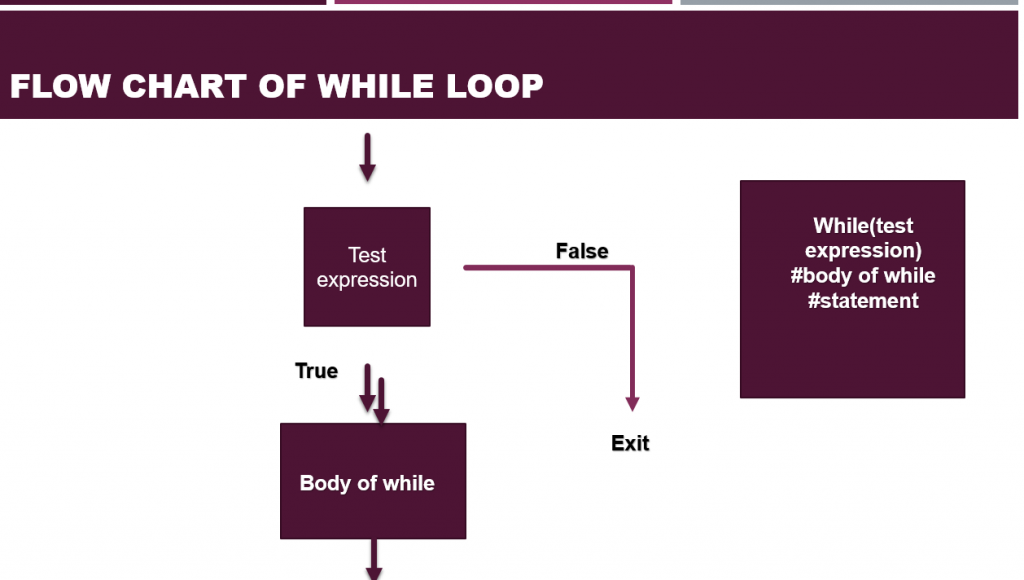
In Python, a while loop executes a block of code repeatedly until a specified condition becomes False. When the condition is no longer true, the program exits the loop and continues execution.
True and never changes, the loop becomes an infinite loop β it will never stop unless you break it manually.
The program begins execution.
Set a value for your control variable (e.g., i = 0).
Evaluate if the condition (i < 5) is true.
Run the code block inside the loop.
Change the value of the control variable (e.g., i += 1).
Go back and recheck the condition.
When the condition becomes False, exit the loop.
i = 1
while i <= 3:
print("Number:", i)
i += 1
# Output:
# Number: 1
# Number: 2
# Number: 3
Practice these real-world Python while loop programs to strengthen your fundamentals. These examples range from beginner to intermediate level, including sum, reverse, factorial, prime check, and more.
count = 1
while count <= 10:
print(count)
count += 1
π€ Output:
1 2 3 4 5 6 7 8 9 10
n = 5
sum = 0
i = 1
while i <= n:
sum += i
i += 1
print("Sum =", sum)
π€ Output: Sum = 15
num = 7
i = 2
flag = 0
while i < num:
if num % i == 0:
flag = 1
break
i += 1
if flag == 0:
print(num, "is a prime number")
else:
print(num, "is not a prime number")
π€ Output: 7 is a prime number
count = 0
while count < 3:
print("Vista Academy Data Science Institute")
count += 1
π€ Output:
Vista Academy Data Science Institute (3 times)
number = 3
i = 1
while i <= 10:
print(f"{number} x {i} = {number * i}")
i += 1
π€ Output: Table of 3
num = 1234
reverse = 0
while num > 0:
digit = num % 10
reverse = (reverse * 10) + digit
num //= 10
print("Reversed number:", reverse)
π€ Output: 4321
def factorial(n):
if n < 0:
return "Not defined"
elif n == 0 or n == 1:
return 1
else:
fact = 1
i = 2
while i <= n:
fact *= i
i += 1
return fact
print(factorial(5))
π€ Output: 120
count = 0
num = 2
primes = []
while count < 10:
is_prime = True
i = 2
while i*i <= num:
if num % i == 0:
is_prime = False
break
i += 1
if is_prime:
primes.append(num)
count += 1
num += 1
print(primes)
π€ Output: [2,3,5,7,11,13,17,19,23,29]
n = 10
i = 2
while i <= n:
print(i)
i += 2
π€ Output: 2 4 6 8 10
num = 456
sum = 0
while num > 0:
digit = num % 10
sum += digit
num //= 10
print(sum)
π€ Output: 15
a = 48
b = 18
while b != 0:
a, b = b, a % b
print("GCD is:", a)
π€ Output: GCD is: 6
num = 67891
count = 0
while num != 0:
num //= 10
count += 1
print("Total digits:", count)
π€ Output: Total digits: 5
num = 153
temp = num
sum = 0
while temp > 0:
digit = temp % 10
sum += digit ** 3
temp //= 10
if num == sum:
print("Armstrong Number")
else:
print("Not an Armstrong Number")
π€ Output: Armstrong Number
n = 7
a, b = 0, 1
i = 0
while i < n:
print(a, end=" ")
a, b = b, a + b
i += 1
π€ Output: 0 1 1 2 3 5 8
num = 968421
smallest = 9
while num > 0:
digit = num % 10
if digit < smallest:
smallest = digit
num //= 10
print("Smallest digit:", smallest)
π€ Output: Smallest digit: 1
num = 121
original = num
reverse = 0
while num > 0:
digit = num % 10
reverse = (reverse * 10) + digit
num //= 10
if original == reverse:
print("Palindrome Number")
else:
print("Not a Palindrome")
π€ Output: Palindrome Number
ch = 65
while ch <= 90:
print(chr(ch), end=" ")
ch += 1
π€ Output: A B C D E F G H I J K L M N O P Q R S T U V W X Y Z
base = 3
exp = 4
result = 1
while exp > 0:
result *= base
exp -= 1
print("Result:", result)
π€ Output: Result: 81
num = 2846
sum = 0
while num > 0:
digit = num % 10
if digit % 2 == 0:
sum += digit
num //= 10
print("Sum of even digits:", sum)
π€ Output: Sum of even digits: 10
text = "Data Science"
i = 0
count = 0
while i < len(text):
if text[i].lower() in 'aeiou':
count += 1
i += 1
print("Total vowels:", count)
π€ Output: Total vowels: 5
Test your knowledge by selecting the correct answer. You’ll get instant feedback!
i = 1
while i < 5:
print(i)
i += 1
x = 10
while x > 5:
print(x)
x -= 2
Quick answers to common doubts about while loops β perfect for beginners.
A while loop is a control flow statement that repeatedly executes a block of code as long as the given condition is True.
An infinite while loop runs endlessly because the condition never becomes False. For example: while True: will run forever unless stopped by a break statement.
Always make sure the condition inside your while loop can eventually become False. Update your loop variable inside the loop to avoid infinite repetition.
Yes! Python allows using an else block with while loop, which runs only when the condition becomes False naturally (not interrupted by break).
You can use a counter variable (like i = 0) and increment it on each iteration to track how many times the loop runs.
– Forgetting to update the loop variable
– Wrong indentation
– Using = instead of ==
– Creating an infinite loop accidentally
Yes, break is used to exit the loop early, and continue is used to skip the current iteration and move to the next one.
while condition:
statement(s)
Example:
i = 1
while i <= 5:
print(i)
i += 1
Real students. Real transformations. From beginners to professionals.
Certified Data Analyst Program


π Every certificate tells a success story.
Call or WhatsApp to book your seat in the next batch
Learn industry tools. Build real dashboards. Crack interviews. Join Vista Academy β Dehradunβs trusted Data, AI & Analytics institute.
Call or WhatsApp us now to book your seat in the next batch