how-to-become-a-data-scientist-from-scratch

πŸš€ How to Become a Data Scientist β€” Step‑by‑Step Roadmap (2025)

Follow a practical, hands‑on path to become a data scientist: learn Python & SQL, master statistics & ML, build portfolio projects, and land your first role β€” even if you’re starting from scratch.

Updated 2025
90‑Day Roadmap
3 Portfolio Projects

Free guide by Vista Academy, Dehradun β€” practical curriculum, live demos & placement support.

Updated for 2025 β€’ Covers: how to become a data scientist, steps to become

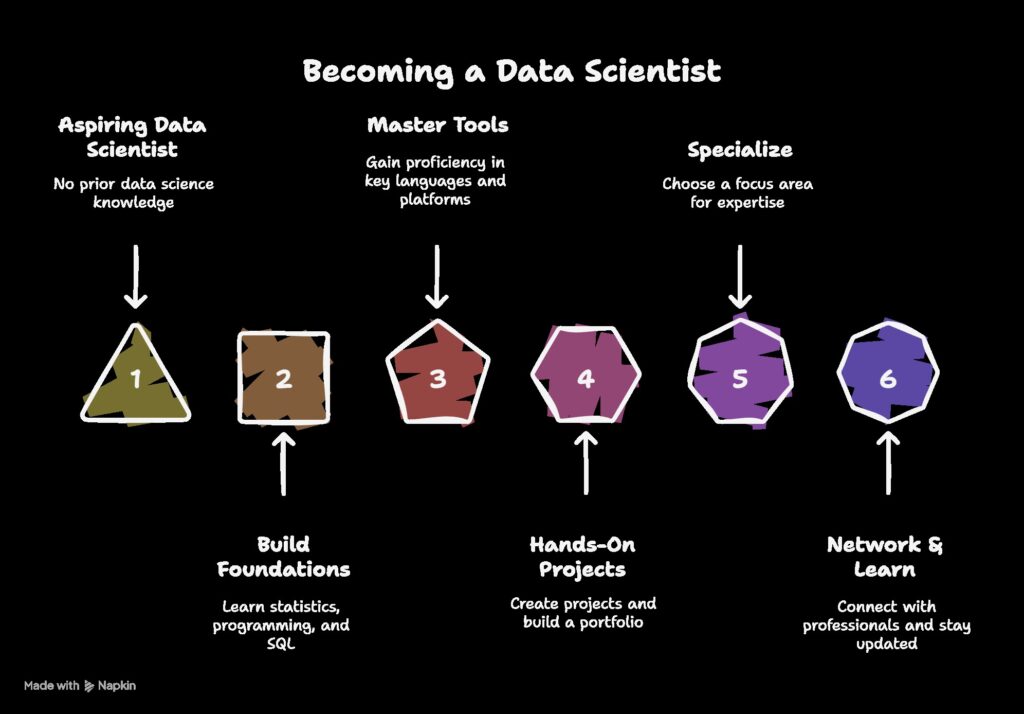
Steps to Become a Data Scientist β€” Practical 10‑Step Roadmap

This concise, action‑driven checklist answers the most searched queries like how to become a data scientist, how to be a data scientist, and data scientist pathway. Each step includes what to learn, practical outcomes, and links to starter resources.

1️⃣ Understand the Role & Career Path

Learn the difference between Data Analyst, Data Scientist, and Machine Learning Engineer. Outcome: a clear target role and 3-month learning plan.

Read: Role & Responsibilities β†’

2️⃣ Learn Programming β€” Python (Pandas, NumPy)

Daily practice: data cleaning, EDA, and small scripts. Outcome: 5 reproducible notebooks showing EDA patterns.

Start Python Tutorials β†’

3️⃣ Strengthen Math & Statistics

Focus on probability, hypothesis testing, distributions, and linear algebra basics. Outcome: ability to evaluate model assumptions and metrics.

See recommended topics β†’

4️⃣ SQL & Data Management

Practice joins, group by, window functions, and basic data modeling. Outcome: solve data requests with SQL queries from sample schemas.

SQL Guide β†’

5️⃣ Data Visualization & Communication

Learn Power BI/Tableau + Matplotlib/Plotly. Outcome: one executive dashboard and a 1‑page insight memo.

Visualization Resources β†’

6️⃣ Machine Learning β€” Core Algorithms

Cover regression, classification, clustering, model validation, and feature engineering. Outcome: 2 end‑to‑end ML projects with evaluation reports.

ML Project Examples β†’

7️⃣ Real‑World Projects & Portfolio

Build projects (churn, forecasting, NLP). Outcome: GitHub repo > README with business impact and reproducible code.

Project Ideas β†’

8️⃣ Big Data & Cloud (Optional)

Basics of Spark, BigQuery, and cloud notebooks. Outcome: one pipeline demo and basic model hosting example.

Cloud & Big Data β†’

9️⃣ Portfolio & Personal Brand

GitHub, LinkedIn, blog posts, and case studies. Outcome: clear narrative showing business value and metrics improved.

Portfolio Tips β†’

πŸ”Ÿ Apply for Internships & Jobs

Target analyst or ML intern roles first. Outcome: 20 tailored applications, 5 interviews, and continuous improvement loop.

Job Application Checklist β†’

🧠 Skills You Need to Become a Data Scientist

A clear blend of technical, mathematical, and soft skills makes you job‑ready. Below are the core skills hiring teams search for β€” include these keywords in your resume and LinkedIn headline.

πŸ“Œ Technical Skills

  • Programming: Python (Pandas, NumPy), R, SQL
  • Data Wrangling: Pandas, ETL basics, Excel
  • Machine Learning: Scikit‑learn, TensorFlow/PyTorch (basics)
  • Visualization: Power BI, Tableau, Matplotlib/Plotly
  • Cloud & Big Data (optional): BigQuery, AWS S3, Spark

Quick tip: Add exact tool names in your resume (e.g., “Pandas, BigQuery”) to match recruiter keyword scans.

πŸ“Š Statistical & Mathematical Skills

  • Probability & Descriptive Statistics
  • Hypothesis Testing & A/B Testing
  • Linear Algebra (vectors, matrices) & Calculus basics
  • Model evaluation metrics (precision, recall, ROC‑AUC)
  • Experimental design & business metrics (LTV, churn)

Quick tip: Show metric improvements in your project READMEs (e.g., “reduced churn by 12% using X model”).

πŸ’‘ Soft Skills

  • Problem solving and hypothesis framing
  • Communication β€” storytelling for non-technical audiences
  • Domain understanding & stakeholder empathy
  • Collaboration: working with product, engineering & business teams
  • Learning mindset & adaptability

Quick tip: Use short case bullets in interviews to show your end‑to‑end impact (Problem β†’ Action β†’ Outcome).

🎯 Best Learning Paths to Become a Data Scientist

There’s no single β€œright” way to become a Data Scientist. Your path to becoming a data scientist depends on your background, budget, and learning style. Below are the most effective pathways in 2025 for students, professionals, and career changers.

πŸŽ“ University Degree Route

Pursue a Bachelor’s or Master’s in Data Science, Computer Science, or Statistics. This traditional path offers strong theoretical foundations and research opportunities.

πŸ’» Online Courses & Bootcamps

Fast‑track your skills through structured programs like Vista Academy’s Data Science Course, Coursera, or DataCamp. Ideal for working professionals or those switching careers.

πŸ“š Self‑Learning & Projects

Learn from free resources like YouTube tutorials, MOOCs, Kaggle competitions, and open‑source datasets. The most flexible and budget‑friendly path, but requires discipline.

πŸ”„ Career Transition

Already working as a Data Analyst, Software Engineer, or Business Analyst? Leverage your background and upskill in ML, statistics, and big data tools to move into Data Science roles.

🎯 Best Learning Paths to Become a Data Scientist

Your path to becoming a data scientist depends on your goals, time, and resources. Here are the four main routes that learners follow in 2025 β€” each offering a unique balance between flexibility, structure, and cost.

πŸŽ“ University Degree Route

Earn a Bachelor’s or Master’s in Data Science, Computer Science, or Statistics. Ideal for those seeking deep theory, academic credibility, or global research exposure.

  • β€’ Duration: 2–4 years
  • β€’ Cost: High
  • β€’ Strength: Strong foundations & peer network

πŸ’» Online Courses & Bootcamps

Structured, mentor-led training programs that fast-track your learning. Programs like Vista Academy’s Data Science Course or Coursera specializations combine practical labs with real-world datasets.

  • β€’ Duration: 3–9 months
  • β€’ Cost: Medium
  • β€’ Strength: Industry readiness & guided learning

πŸ“š Self-Learning & Projects

Use free or low-cost resources β€” YouTube, MOOCs, Kaggle, and GitHub β€” to learn at your own pace. Best for independent learners who enjoy exploring.

  • β€’ Duration: 6–12 months (flexible)
  • β€’ Cost: Low
  • β€’ Strength: Flexibility & project-driven learning

πŸ”„ Career Transition

If you’re a Data Analyst, Software Engineer, or Business Analyst, you already have relevant foundations. Build on them by mastering machine learning, cloud, and statistics.

  • β€’ Duration: 6–12 months
  • β€’ Cost: Medium
  • β€’ Strength: Quick transition using existing skills

πŸ”„ How to Switch Your Career to Data Science

Thinking of changing your career? You can switch to Data Science even if you come from non-technical, analytics, or IT backgrounds. Follow these transition playbooks to map your strengths and fill your skill gaps effectively.

πŸ“Š From Data Analyst

You already understand data cleaning, SQL, and dashboards. Learn machine learning, feature engineering, and predictive analytics to move into a Data Scientist role.

  • Focus: ML algorithms & model evaluation
  • Timeline: 4–6 months
  • Recommended: Vista Academy’s ML specialization

πŸ’» From Software Engineer

You’re fluent in programming β€” your next step is learning statistics, EDA, and ML pipelines. Transition easily into applied ML or MLOps roles with small projects.

  • Focus: ML workflows, APIs, data pipelines
  • Timeline: 3–5 months
  • Recommended: Deploy one ML model to cloud

πŸ“ˆ From Business Analyst

Leverage your domain knowledge and Excel/BI background by adding Python, SQL, and ML skills. You can quickly move into data-driven decision-making roles.

  • Focus: Predictive analytics & visualization
  • Timeline: 4–6 months
  • Recommended: Build a business case ML project

πŸ“š From Non-Technical Background

Start from fundamentals: Excel, statistics, and Python. Progress into SQL, data visualization, and then beginner ML projects. Your portfolio will matter more than your degree.

  • Focus: Python, SQL, Power BI basics
  • Timeline: 6–9 months
  • Recommended: Vista Academy’s Foundation Batch

πŸ“Š Comparison of Career Transition Paths

Path Core Focus Timeline Key Tools
Data Analyst Machine Learning, Model Tuning 4–6 months Python, Scikit-learn, Tableau
Software Engineer ML Pipelines & APIs 3–5 months TensorFlow, FastAPI, SQL
Business Analyst Predictive Analytics 4–6 months Power BI, Python, Excel
Non-Technical Foundations + Projects 6–9 months Excel, Python, Power BI

πŸ“… 90-Day Roadmap to Become a Data Scientist

Wondering how to become a data scientist from scratch? Follow this 3-month action plan to go from beginner to job-ready. Each phase focuses on essential tools, concepts, and projects to help you stand out.

πŸ—“οΈ Month 1: Learn the Foundations

  • βœ… Learn Python (syntax, loops, libraries like Pandas & NumPy)
  • βœ… Understand Statistics & Probability basics
  • βœ… Master Excel & SQL for data manipulation
  • βœ… Practice small EDA tasks with datasets from Kaggle

Goal: Be comfortable writing Python scripts and querying data confidently.

🧠 Month 2: Machine Learning & Visualization

  • βœ… Learn EDA & Data Visualization using Power BI or Matplotlib
  • βœ… Study Supervised Learning (regression, classification)
  • βœ… Explore Unsupervised Learning (clustering, PCA)
  • βœ… Implement 2 projects: Sales Prediction & Customer Segmentation

Goal: Build and evaluate ML models using Scikit-learn; visualize insights effectively.

πŸš€ Month 3: Portfolio & Job Readiness

  • βœ… Build 1 domain project (Finance, Retail, or Healthcare)
  • βœ… Upload projects on GitHub with clear READMEs
  • βœ… Optimize your LinkedIn & resume with keywords
  • βœ… Prepare for Data Science Interviews

Goal: A complete portfolio with 3 projects + professional profile for job applications.

πŸ’‘ Pro Tips for Success

  • πŸ“ˆ Consistency beats intensity β€” study 1–2 hours daily.
  • 🀝 Join Data Science communities on LinkedIn & Kaggle.
  • 🧰 Document every project β€” recruiters love clear GitHub READMEs.
  • 🎯 Keep a β€œlearning log” to show your growth journey in interviews.

❓ Frequently Asked Questions

Quick answers to the most searched queries about becoming a Data Scientist in 2025.

How to become a data scientist step by step?
Learn Python & SQL β†’ Stats/Math β†’ EDA & Visualization β†’ ML (regression, classification, clustering) β†’ 3 portfolio projects β†’ GitHub/Blog β†’ interview prep.
How can I become a data scientist from scratch?
Follow a 90‑day plan: 30d foundations (Python/SQL/Stats), 30d ML + 2 projects, 30d domain project + resume + mock interviews. Consistency > intensity.
How to start a data science course?
Pick one track (free or paid), set a weekly schedule (skills β†’ projects β†’ portfolio), and measure outcomes (1 project per month, 1 blog/README per project).
Can I become a data scientist without a degree?
Yesβ€”prove skills via portfolio (3+ projects), internships, Kaggle, and open‑source PRs. Showcase measurable impact in READMEs and LinkedIn posts.
Can I become a data scientist without coding?
Not realistically. Low‑code tools help, but Python & SQL are core. Start with basics and build gradually; combine with analytics/BI to transition.
How long does it take to become a data scientist?
Typical range: 3–6 months (intensive, prior experience) to 9–12 months (beginner). Focus on outcomes: 3 strong projects + portfolio + interview readiness.
Data Scientist vs Data Science Engineer β€” what’s the difference?
Scientist: modeling, experimentation, insights. DSE: pipelines, data platforms, model deployment (MLOps). Many roles overlap in smaller teams.
Is there a 90‑day roadmap to get started?
Yesβ€”see the 90‑Day Roadmap: Weeks 1–4 (Python/SQL/EDA), Weeks 5–8 (ML + 2 projects), Weeks 9–12 (domain project + portfolio + interviews).
How to switch to data science from a Data Analyst/BA/SE role?
Map your gaps, add ML/statistics, practice with 2–3 targeted projects, and showcase business impact. Use your domain knowledge as a differentiator.

πŸ”„ How to Switch Your Career to Data Science

You don’t always need to start over to become a Data Scientist. Many professionals successfully transition from related fields by building on their existing skills. Here’s how to switch your career to data science whether you are a Data Analyst, Software Engineer, Business Analyst, or from a non‑technical background.

πŸ“Š From Data Analyst

You already have strong foundations in data cleaning and visualization. Upskill by learning machine learning algorithms, statistical modeling, and cloud/big data tools to step up into a Data Scientist role.

πŸ’» From Software Engineer

With coding skills already in hand, focus on Python for data analysis, SQL for data extraction, and frameworks like TensorFlow/PyTorch to move into applied machine learning.

πŸ“ˆ From Business Analyst

Build on your business knowledge by adding advanced analytics, predictive modeling, and basic data engineering skills. This makes you a strong candidate for data‑driven decision roles.

πŸ“š From Non‑Technical Backgrounds

Start with basics: Excel, statistics, and Python. Progress into SQL, visualization (Power BI/Tableau), and then hands‑on machine learning projects. A portfolio is critical here.

πŸ“Š Comparison of Learning Paths

Path Duration Cost Best For
πŸŽ“ University Degree 2–4 years High Students seeking strong theory & research
πŸ’» Bootcamps/Online Courses 3–9 months Medium Career changers needing structure
πŸ“š Self‑Learning Flexible (6–12 months typical) Low Disciplined learners with budget limits
πŸ”„ Career Transition 6–12 months Medium Professionals leveraging existing domain skills

❓ Career Switch FAQs

Can I become a Data Scientist without coding?

Basic coding in Python/SQL is essential, but you don’t need to be an expert developer. Start with beginner‑friendly data analysis tasks and gradually move to ML scripting.

How long does it take to switch careers to Data Science?

With consistent effort, most professionals can transition in 6–12 months by following a structured learning roadmap, projects, and internships.

Do I need a degree to switch into Data Science?

Not necessarily. A strong portfolio with real‑world projects, internships, and certifications can often substitute for a formal degree.

βœ… Data Science Roadmap Checklist

Use this interactive checklist to track your journey to becoming a Data Scientist. Tick off each stage as you complete itβ€”from foundations to portfolio and career transition.

πŸ“š Foundations

  • Basic Statistics & Probability
  • Linear Algebra & Calculus (basics)
  • Excel / Google Sheets for Data

πŸ’» Programming & Tools

  • Python (Pandas, NumPy)
  • SQL for Databases
  • Data Visualization (Matplotlib, Power BI)

πŸ€– Machine Learning

  • Regression & Classification
  • Clustering & Recommendation
  • Deep Learning (basics)

πŸ“Š Real‑World Projects

  • Kaggle / OpenML datasets
  • 3 Portfolio Projects (Retail, Finance, Healthcare)
  • Blog/Case Study for each project

πŸ“ Portfolio & Networking

  • GitHub Repo with Clean README
  • LinkedIn Posts / Blog Writing
  • Kaggle Participation

πŸš€ Career Preparation

  • Resume & Interview Prep
  • Apply for Internships
  • Target Entry‑Level DS Roles

πŸ“ Data Science Roadmap β€” Click to Expand

Tap each step to reveal bite-size guidance and links. This block is script-free and safe to paste.

1️⃣ Foundations β€” Math & Statistics

Focus: Probability, distributions, hypothesis testing, linear algebra basics.

Quick links: What is Data Analytics

2️⃣ Programming & Tools β€” Python, SQL, Pandas

Focus: Python (Pandas, NumPy), SQL, Jupyter notebooks.

Quick links: 10 Steps to Become a Data Scientist

3️⃣ Data Visualization β€” Power BI / Tableau

Focus: Storytelling with dashboards and executive summaries.

Quick links: Excel & Data Cleaning

4️⃣ Machine Learning β€” Regression, Classification, Clustering

Focus: Model selection, cross-validation, feature engineering.

5️⃣ Real-World Projects β€” Build Portfolio

Focus: 3 end-to-end projects: problem β†’ model β†’ deployment/docs.

Quick links: Project Ideas

6️⃣ Big Data & Cloud (Optional)

Focus: Spark, BigQuery, AWS/GCP basics when needed for scale.

7️⃣ Jobs & Interviews β€” Apply & Network

Focus: Resume, GitHub, case interviews, LinkedIn outreach.

πŸŽ“ Join Free Demo

❓ Frequently Asked Questions β€” Become a Data Scientist

Get quick answers to the most searched questions like how to become a data scientist, skills needed, career switch, and more. These FAQs address the top Google and GSC queries for 2025.

How to become a data scientist step by step?

Start with Python and SQL β†’ Learn statistics and machine learning β†’ Build 3 real-world projects β†’ Publish on GitHub and LinkedIn β†’ Apply for internships or entry-level data roles.

Can I become a data scientist without a degree?

Yes. A portfolio showcasing your skills (3+ projects), certifications, and internships can replace the need for a formal degree in most companies.

How long does it take to become a data scientist?

For beginners, it typically takes 6–12 months with consistent practice. If you already know Python or SQL, you can fast-track your learning to 3–6 months.

Can I become a data scientist from a non-technical background?

Yes β€” start with Excel, Python, and statistics. Gradually progress to SQL, visualization tools, and machine learning projects. Focus on problem-solving and storytelling.

What are the essential skills for a data scientist?

Core skills include Python, SQL, statistics, data visualization, and machine learning. Soft skills like communication and business understanding are equally vital.

Is data science a good career in 2025?

Absolutely. Data Science is among the fastest-growing fields with high demand, attractive salaries, and opportunities in every major industry β€” from finance to healthcare.

πŸš€ Your Journey to Becoming a Data Scientist Starts Now

You’ve learned the step-by-step path to become a Data Scientist β€” from mastering fundamentals to building projects and networking. Now it’s time to take action! Consistency, curiosity, and community will propel you forward.

πŸŽ“ Join Our Free Demo Class & Begin Today
Quiz

Test: Become a Data Scientist β€” Quick MCQs

Question 1 / 5
Vista Academy – 316/336, Park Rd, Laxman Chowk, Dehradun – 248001
πŸ“ž +91 94117 78145 | πŸ“§ thevistaacademy@gmail.com | πŸ’¬ WhatsApp
πŸ’¬ Chat on WhatsApp: Ask About Our Courses